
Article Highlights
- Steel fabrication transforms raw steel into functional components through cutting, bending, welding and finishing processes that meet strict Australian Standards
- The industry supports billions of dollars worth of structural projects annually, from METRONET rail infrastructure to Pilbara mining operations
- Choosing a local fabrication partner ensures compliance with regional wind loads, cyclonic ratings and faster delivery for time-sensitive builds
Steel Fabrication Work Explained
Steel fabrication is the industrial process of cutting, shaping, welding and finishing raw steel materials to create finished components or structures. Unlike general metal fabrication, which might work with aluminium, copper or brass, steel fabrication focuses exclusively on carbon steel, stainless steel and alloy grades. The primary difference lies in the material properties: steel offers superior strength-to-weight ratios and load-bearing capacity, making it the go-to choice for structural applications.
A steel fabrication business takes flat steel plates, hollow sections or rolled beams and transforms them into anything from lighting poles to building frames. At G&S Industries, we’ve been doing exactly that for over 50 years, supplying galvanised steel poles designed to withstand Western Australia’s harsh coastal conditions and cyclonic wind regions.
Raw materials arrive as plate metal, sectional metal (like circular or square hollow sections) or structural shapes from steel mills. Our fabricators then apply technical expertise and precision machinery to turn those materials into components that meet project specifications down to the millimetre.
Key Steel Fabrication Processes
Modern steel fabrication combines traditional trades with advanced automation. Here’s how raw steel becomes a finished product:
Cutting
CNC laser cutters and plasma cutting machines slice through steel plate with high accuracy, guided by computer-aided design files. For thicker sections or poles, cold saws and band saws handle the job. Plasma cutters are particularly useful when speed matters; they can process multiple pieces simultaneously and adapt to various shapes without retooling.
Bending and Forming
Press brakes apply controlled force to bend flat steel into angles, channels or custom profiles. Section rollers curve steel into cylinders for pole shafts or curved architectural features. The trick is calculating spring-back: steel wants to return to its original shape, so fabricators overbend slightly to achieve the desired final angle.
Welding and Assembling
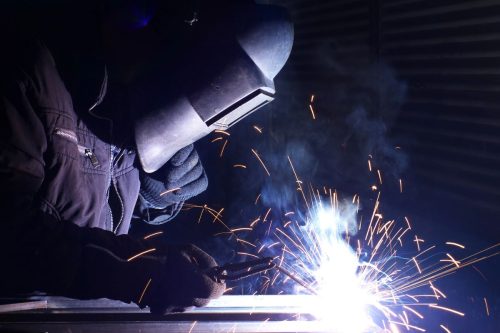
MIG (metal inert gas), TIG (tungsten inert gas) and submerged arc welding join steel components into assemblies. Robotic welding cells now handle repetitive seams, boosting improved consistency and speed compared to manual methods. Skilled welders still tackle complex joints and site-specific modifications that machines can’t replicate.
Surface Finishing
Hot-dip galvanising coats steel in zinc for corrosion resistance, critical in salty coastal air or industrial environments. Powder coating adds colour and an extra protective layer in a controlled environment, with TGIC-free polyester systems now standard to meet updated WA environmental guidelines. Together, these finishes extend service life by decades.
Quality Control in Steel Fabrication
Compliance isn’t optional. Every fabricated steel component destined for public infrastructure or commercial construction must meet Australian Standards, starting with AS 4100:2020 for steel structures and AS/NZS 5131:2016 for fabrication and erection. The National Construction Code 2022 references these standards directly, making them mandatory for all primary structural steel work.
Quality standards are enforced through the National Structural Steelwork Compliance Scheme (NSSCS), which grades fabricators into categories CC1 through CC4 based on their systems and oversight. Government projects increasingly specify minimum CC2 certification, which requires ISO 9001 quality management, documented welding procedures and regular third-party audits.
Inspection happens at multiple stages: incoming material checks, in-process dimensional verification, non-destructive testing of welds (ultrasonic or radiographic) and final load testing where required. For poles and towers, wind region ratings and terrain categories must be calculated and stamped by a qualified engineer before dispatch.
At G&S Industries, our custom design and engineering team runs every pole through structural analysis software that accounts for site-specific wind loads, ensuring structural integrity before fabrication begins. That upfront rigour prevents failures and keeps projects on schedule.
Steel Fabrication in Modern Construction
Why does steel dominate infrastructure projects? Three reasons: speed, sustainability and adaptability.
Fabricated steel frames can be erected faster than poured concrete, cutting labour costs and weather delays. Pre-engineered components arrive ready to bolt together, which matters when you’re racing to meet a council deadline or capitalise on a mining boom.
Recyclability is another advantage. A large majority of structural steel in Australia contains recycled content, helping projects earn Green Star points and meet IS Rating benchmarks. Every tonne recycled saves tonnes of both iron ore and CO₂, making steel one of the most sustainable construction materials available.
Steel also adapts to tough environments. High-strength low-alloy (HSLA) grades deliver the same load-bearing capacity as heavier sections, reducing foundation costs. Weathering steels develop a protective rust layer that eliminates the need for painting in some applications. For cyclonic regions like the Pilbara or coastal Geraldton, properly galvanised and powder-coated steel poles outlast timber alternatives by decades.
Take our mid-hinged poles as an example: they tilt down for maintenance without cranes or cherry pickers, reducing overall downtime. That’s a real-world benefit for councils managing hundreds of streetlights or mine sites with remote infrastructure.
Steel Fabrication in Western Australia
Western Australia’s construction landscape is booming, and steel fabrication sits at the centre of it. The newly finished $15 billion METRONET rail expansion needed catenary poles and station structural steel throughout the build. Pilbara iron-ore projects like BHP’s South Flank and Rio Tinto’s Gudai-Darri require conveyor gantries, lighting structures and transmission towers. FMG’s Windarra wind farm demands turbine pylons engineered for extreme wind loads.
Choosing a local steel fabrication company isn’t just about supporting WA jobs. It’s about working with fabricators who understand cyclonic wind ratings, who can freight long poles to remote mine sites without multi-week lead times, and who know the compliance requirements of Western Power, Main Roads WA and local councils inside out.
What Industry is Steel Fabrication Part Of?
Steel fabrication sits within the broader manufacturing sector, specifically under fabricated metal product manufacturing. The steel industry supplies construction, mining, energy, transport and agriculture, making it a backbone of the national economy.
Demand is driven by infrastructure projects, residential buildings, industrial facilities and renewable energy installations. Steel fabricators serve architects, builders, project managers, government authorities and private developers, each with distinct compliance requirements and timelines. The fabrication industry also intersects with supply chains for raw materials (steel mills, importers), machinery (CNC equipment, welding robots) and logistics (freight, installation contractors).
Skills shortages remain a challenge for this industry, which is pushing fabricators toward automation and advanced manufacturing techniques to maintain output and quality standards.
Choosing the Right Steel Fabrication Services
Not all fabricators are equal. When you’re evaluating steel fabrication services, ask about certifications first. ISO 9001 quality management and NSSCS category ratings signal a serious operation. Check whether they hold in-house engineering capability or outsource design work; integrated teams catch issues earlier and iterate faster.
Delivery capability matters, especially for regional or remote projects. Can they handle oversized freight? Do they stock common pole sizes for urgent orders, or is everything made to order with six-week lead times?
References and recent projects tell you what they’ve actually delivered. A fabricator with a track record in cyclonic regions or mining infrastructure brings lessons learned that save you time and money. Look for partnerships with major utilities or government bodies, which typically demand rigorous compliance and on-time performance.
Finally, consider value beyond price. A cheaper quote from an interstate supplier might balloon once you factor in freight, rectification work for non-compliant components, or delays from poor communication. We’ve seen it happen. At G&S Industries, we offer a turnkey pole package: design, fabrication, surface finishing, delivery and installation support, all backed by more than 50 years of local knowledge.
Ready to specify steel poles that meet your wind region, height and load requirements? Get a quote through our online tool, or call us to discuss your project.
Frequently Asked Questions
Steel fabrication is the industrial process of cutting, bending, welding and finishing raw steel materials to create structural components, poles, frames and custom assemblies that meet engineering specifications and Australian Standards.
Steel fabrication belongs to the fabricated metal product manufacturing sector. It supports construction, mining, energy, transport and infrastructure projects nationwide in Australia.
A steel fabrication business transforms raw steel into finished products through cutting, forming, welding and coating processes. Many also offer design, engineering, delivery and installation services for complete project solutions.
Steel fabrication work requires welding certifications (MIG, TIG, arc welding), blueprint reading, CNC machine operation, quality control knowledge and understanding of Australian Standards. Problem-solving and attention to detail are essential for ensuring structural integrity.