
Article Highlights
- Steel poles offer fire resistance, pest immunity and minimal maintenance, making them ideal for bushfire-prone and coastal zones.
- Australian Standards AS/NZS 7000 govern pole material selection, structural design and compliance for overhead distribution and transmission lines.
- Power pole materials in Australia include timber, steel, concrete and composite FRP, each suited to different environmental conditions and project requirements.
In Australia, we face some of the harshest conditions on the planet: cyclonic winds up north, bushfire risk through the south-east, and salt-laden air along the coast. That’s why understanding the strengths and limitations of each pole material is so important. If you’re specifying distribution poles for a new subdivision or replacing private power poles on rural land, the decision needs to match your site’s wind region, terrain category and environmental exposure.
Timber Poles
Wooden utility poles have been the backbone of rural distribution networks for decades. Treated hardwood remains a familiar sight along country roads, supporting lower voltage power lines and telecommunications cables.
The appeal of wood poles lies in their availability and the fact that installation crews already know how to work with them. You don’t need specialised plant or welding gear, and replacement is usually straightforward.
That said, timber does have its limits. Even with copper zinc arsenate treatment to resist termites and rot, wooden poles need regular inspection. Bushfire risk is real, and in fire-prone areas, network owners are progressively moving away from hardwood in favour of non-combustible alternatives. Moisture, pests and ground-level decay can all shorten a pole’s life expectancy, especially in poor soil conditions.
If you’re working in a low-risk rural area where the budget is tight and bushfire exposure is minimal, timber can still do the job. Just factor in ongoing maintenance and the possibility of earlier replacement compared with other materials.
Steel Poles
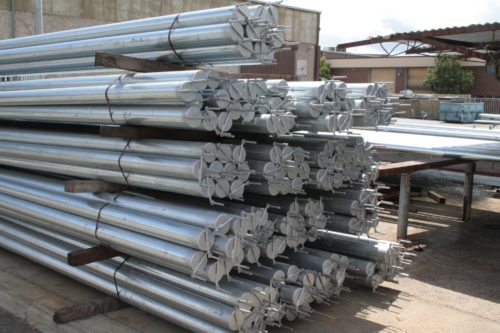
Steel poles are becoming the go-to choice for utilities, councils and private developers who want long service life with minimal fuss. Hot-dip galvanised steel utility poles resist fire, pests and corrosion, and they deliver consistent structural performance across a wide range of applications.
You’ll find steel used for street lighting, power distribution, telecommunications monopoles and even high-voltage transmission lines. The material suits both urban areas, where a slimmer profile reduces visual clutter, and coastal zones, where salt spray would eat through untreated timber or corrode less robust metals.
One of the big advantages of steel is design flexibility. Manufacturers can produce tapered tubular poles, swaged poles, stepped poles or hybrid designs like the South Australian Stobie pole (twin galvanised channels filled with concrete). Many Australian-made steel poles come with built-in maintenance steps and pre-drilled mounting holes, which speeds up installation and makes future upgrades easier.
Hot-dip galvanising provides a thick zinc coating that protects the base metal for decades. In particularly aggressive environments, you can add a powder-coat finish for extra corrosion resistance or to meet aesthetic requirements. Because steel is self-supporting and uniform in quality, you get predictable load ratings and fewer on-site surprises.
If you’re comparing wooden vs steel power poles, steel typically wins on life-cycle cost. The upfront price might be higher, but you save on inspections, treatments and early replacements.
Concrete Poles
Concrete utility poles, either spun or pre-stressed, are another durable option. They’re especially popular in cyclonic regions and coastal areas where high winds and salt exposure demand serious rigidity.
Reinforced concrete won’t burn, rot or attract termites, and it holds up well in extreme heat. The material is dense and heavy, which gives it excellent resistance to lateral loads. That same weight, though, means transport and installation require larger cranes and careful site access planning.
Concrete poles are often specified for transmission lines and taller distribution poles where wind loading is a major concern. They’re also a solid choice in areas with expansive clay soils, where ground movement can stress lighter materials.
The trade-off is reduced flexibility during installation. Once a concrete pole is in the ground, modifications are harder than with steel, and if a pole does fail, replacement is a bigger job. Still, if your project sits in a high-wind or coastal zone and you need a pole that will stand firm for decades with minimal maintenance, concrete deserves serious consideration.
Composite and FRP Poles
Composite poles made from fibre-reinforced polymer (FRP) are the newest entrants to the Australian market. These poles use glass-fibre strands embedded in a resin matrix, resulting in a lightweight, non-conductive structure that resists corrosion and doesn’t conduct electricity.
FRP poles weigh significantly less than concrete or steel, which simplifies handling in difficult terrain and reduces transport costs. Because they’re non-conductive, live-line work becomes safer and faster. That makes them attractive for telecommunications poles and distribution lines in environmentally sensitive zones where minimal ground disturbance is a priority.
The catch is cost and supply. Composite poles are more expensive upfront, and the local supply chain is still developing compared with timber, steel or concrete. Not every contractor is familiar with FRP installation techniques, and long-term field data in Australian conditions is still building.
Transmission Poles vs Distribution Poles
It’s worth noting the difference between transmission line pole types and distribution poles. Transmission poles carry high voltage electricity over long distances, often using lattice steel towers or very tall tubular steel or concrete poles. These structures need to handle extreme loads, ice accumulation (in some regions) and significant span lengths.
Distribution poles, by contrast, support lower voltage power lines that deliver electricity to homes and businesses. They’re shorter, more numerous, and often carry multiple purposes: power lines, telephone lines, street lights and communications cables on the same poles.
The material you choose depends on the application. Transmission poles almost always use steel or concrete because of the loads involved. Distribution poles offer more flexibility, and that’s where timber, steel, concrete and composite all compete.
Australian Standards and Compliance
All new overhead lines in Australia must comply with AS/NZS 7000:2016 Overhead Line Design. This standard sets out the structural, electrical and safety requirements for poles, wires and associated equipment. It covers acceptable pole materials, load calculations for different wind regions and terrain categories, and additional factors like bushfire and cyclonic conditions.
If you’re specifying poles for a project, your engineer will need to confirm that the chosen material and design satisfy AS/NZS 7000. That includes checking pole length, embedment depth (the minimum depth the pole must be buried underground), and the capacity to support electrical equipment, wires and cables without exceeding stress limits.
Hot-dip galvanised steel poles manufactured in Australia typically come with certification and design documentation that streamlines the approval process. Concrete and composite poles should also arrive with compliance paperwork from the supplier.
Ignoring standards isn’t an option. Non-compliant poles put lives at risk, void insurance, and can trigger costly retrofits or replacements down the track.
Choosing the Right Pole Material
So which power pole types suit your project? Start by looking at your site conditions. Bushfire-prone areas favour steel or concrete. Coastal zones need corrosion-resistant materials like galvanised steel, stainless-clad steel or spun concrete. Cyclonic regions benefit from the rigidity of concrete or heavy-duty steel designs.
Budget matters, but don’t stop at the purchase price. Factor in installation costs, maintenance schedules and expected service life. A cheaper timber pole that needs re-treatment or replacement in fifteen years might cost more over its life than a steel utility pole that lasts forty years with minimal attention.
If you’re working on a private power pole replacement, check with your local network operator about approved materials and any specific design requirements. Some utilities maintain preferred-supplier lists or mandate particular pole types for grid connections.
For larger projects, talk to your structural engineer early. They’ll run the load calculations, confirm wind region ratings, and recommend pole materials that meet AS/NZS 7000 without over-engineering. Getting this right at the design stage saves time, money and headaches during construction.
Why Material Choice Matters
Power poles might not be glamorous, but they’re the skeleton of our electrical grid. Pick the wrong material and you’re looking at premature failure, safety hazards and unplanned outages. Choose wisely and you get reliable infrastructure that supports community growth for decades.
Steel poles offer a compelling mix of strength, durability and low maintenance, especially in bushfire and coastal environments. Timber remains cost-effective in low-risk rural settings. Concrete delivers unmatched rigidity in cyclonic zones. Composite FRP is carving out a niche where weight and non-conductivity matter most.
Whatever material you land on, make sure it aligns with Australian Standards, suits your site’s environmental exposure, and fits within your project’s whole-of-life budget. And if you need expert advice on specifying the right power pole types for your next job, we’re here to help. Get in touch with our team at G&S Industries and we’ll walk you through the options.
Frequently Asked Questions
Internal cable channels use snap-in dividers to keep mains power, low-voltage data and fibre runs physically separated. Separate entry glands and labelled terminations meet AS/NZS 3000 wiring rules and make future maintenance straightforward.
Lockable hand-hole doors at service height (typically 1.5 to 2 metres) let technicians access terminations, swap modules and run new cables without a crane or elevated work platform. Mid-hinged poles offer full lowering access where required.
It depends on the pole's age, material and current load. Older concrete or timber columns often lack the spare capacity for antennas and cameras. We recommend a structural assessment before retro-fitting. In many cases, replacing with a purpose-built multifunction pole is safer, faster and more cost-effective.